By Mohd Jamizal Zainol
For many years, the corporate lawyer was primarily regarded as a gatekeeper. Business developed an idea, negotiated the commercial terms and eventually brought the matter to Legal. The lawyer examined the law, identified the risks and answered the familiar question: Can we do it?
That question remains fundamental. But in an increasingly complex corporate environment, it is no longer enough.
A company may have the legal right to terminate a supplier, sue a business partner, restructure its workforce or exploit a favourable contractual provision. Yet the existence of a legal right does not necessarily mean exercising that right is wise.
This is where the modern legal adviser must evolve.
I see the progression in three questions.
The traditional lawyer asks: Can we do it?
The strategic adviser asks: How can we do it responsibly?
The institutional counsellor asks: Even if we can do it, should we?
The first requires knowledge of law. The second requires commercial understanding. The third requires something more difficult: judgement and character.
Having a Right and Exercising It
Consider a hypothetical example.
A long-term contractor commits an administrative breach. Under a strict interpretation of the contract, the company may be entitled to impose substantial liquidated damages.
Legal reviews the contract and concludes: “Yes, we have the contractual right.”
Technically, the lawyer has answered the question.
But suppose the contractor has worked with the company for 15 years. The breach has been corrected. The actual operational impact was limited. The contractor is also strategically important to several future projects.
The senior legal adviser should then ask: We know we can enforce our right, but should we?
Would doing so be proportionate? What was the commercial purpose behind the provision? Would strict enforcement destroy a valuable relationship? Would suppliers price that behaviour into future contracts?
The legal right remains. But having a right and deciding to exercise it are two different things.
The first is a question of law. The second requires judgement.
Consider another example. A senior executive consistently produces exceptional financial results but there are repeated complaints about how he treats employees. An investigation establishes troubling behaviour, although perhaps not enough to require dismissal under applicable employment law.
Legal may conclude: “The company can retain him.”
But leadership must ask: “Should we?”
If he remains because “he delivers”, what does that tell employees about the organisation’s values? What happens to every corporate statement about respect, integrity and speaking up?
Sometimes the most consequential corporate decisions are perfectly legal.
From Risk Identification to Decision-Making
Business necessarily involves risk. A company that eliminates every legal risk will eventually eliminate much of its opportunity.
Therefore, the role of Legal cannot simply be to identify risks.
A developing lawyer might tell management: “There is significant legal risk.”
A senior adviser must go further.
Imagine an acquisition where Legal discovers litigation exposure, Compliance has concerns about an intermediary, Finance sees attractive economics and Commercial sees an important market opportunity.
Management does not need four disconnected reports.
It needs one coherent decision.
The senior legal adviser might say:
“We have three material exposures. The first can be addressed through a condition precedent. The second can be mitigated through an indemnity. The third cannot realistically be transferred. If management accepts that residual exposure, my recommendation is that we proceed subject to these protections.”
Legal has now moved from identifying risk to helping management make decisions under risk.
That is the difference between being a legal technician and becoming a trusted adviser.
Law Establishes the Boundary, Not Always the Destination
This distinction becomes particularly important when exercising corporate power.
Suppose a company has a strong contractual case against a joint-venture partner. External counsel assesses its prospects of success at 75 per cent.
Can the company sue?
Probably.
Should it?
That requires a different analysis.
Perhaps the disputed amount is RM20 million, while the relationship between the companies spans several projects worth billions. Litigation could require disclosure of sensitive information, consume management time and permanently damage the relationship.
A sophisticated adviser might therefore recommend preserving the company’s legal rights while first pursuing a negotiated commercial solution.
This is not weakness. Nor is it abandoning the law.
It is understanding that law operates within a larger institutional reality.
A good lawyer tells the company what its rights are. A great legal adviser helps the company decide when exercising those rights is wise.
From Compliance to Ihsan
There is an Islamic concept that, in my view, adds a profound dimension to this discussion: ihsan.
In the famous Hadith of Jibril, the Prophet Muhammad ﷺ was asked about Islam, iman and ihsan. When asked about ihsan, he replied, in meaning:
“That you worship Allah as though you see Him; and if you do not see Him, indeed He sees you.”
The hadith is narrated in Sahih Muslim and is among the foundational texts describing the dimensions of Islam, faith and spiritual excellence.
Ihsan is usually discussed in the context of worship and spiritual life. But its moral insight has wider significance.
At its heart is the idea that the quality of our conduct should not depend merely upon whether another human being is watching.
This provides an illuminating way to think about corporate ethics.
Compliance asks: “Is anyone watching?”
Law asks: “Is this permitted?”
Ihsan asks: “What is the right thing to do even when nobody is watching?”
Of course, a corporation is not a religious person, and corporate governance should not substitute religious doctrine for law. In a diverse workplace, employees may derive their ethical commitments from different religious, philosophical and cultural traditions.
But ihsan offers a powerful ethical insight: external supervision is not enough; good conduct ultimately requires an internal moral compass.
When Nobody Is Watching
Companies spend enormous resources building external controls.
We have policies, approval matrices, compliance programmes, whistleblowing channels, risk registers, internal auditors and external auditors.
All are necessary.
But no system can observe every decision.
Compliance cannot attend every meeting. Legal cannot read every email. Internal Audit cannot inspect every transaction. The Board cannot watch every employee.
Eventually, every governance system reaches a point where someone must make a decision when nobody is watching.
That is where character matters.
A procurement officer discovers that nobody is likely to detect a minor conflict of interest.
An executive realises that an aggressive interpretation of a policy would improve his performance figures.
A manager has the opportunity to conceal a mistake that may never be discovered.
A lawyer discovers a contractual loophole that could disadvantage a weaker counterparty.
What happens next cannot be explained by compliance systems alone.
The answer depends upon the values living within the person making the decision.
This is why I distinguish ethics from morality.
For me, ethics is the architecture of values within us, formed through religion, culture, family, education, philosophy and experience.
Morality is the manifestation of those values through our conduct.
Ihsan pushes the idea further: the highest standard of conduct is not behaviour produced by surveillance, but conduct arising from an awareness that doing right has intrinsic meaning even when external enforcement is absent.
The Chief Legal Adviser as Institutional Counsellor
This also explains why artificial intelligence will not diminish the importance of senior legal judgement.
AI will become increasingly capable of answering: “What does the law say?”
It can review contracts, summarise regulations, identify inconsistencies and analyse legal information at extraordinary speed.
Legal knowledge will become less scarce.
Judgement will become more valuable.
The Chief Legal Adviser of the future must therefore be more than the person who knows the most law.
He or she must understand business, people, risk, reputation, institutional values and long-term consequences.
The adviser must be close enough to the business to understand its objectives, yet independent enough to challenge management when necessary.
Most importantly, the adviser must understand the limits of his own role. Asking “should we?” does not make Legal the moral ruler of the corporation. The Board and management remain responsible for corporate decisions.
The role of the trusted adviser is to ensure that those decisions are made with a clear understanding not only of what the company is legally entitled to do, but what kind of institution it wishes to become.
The progression is therefore simple but profound.
Can we do it? — legal knowledge.
How can we do it responsibly? — commercial judgement.
Should we do it? — institutional wisdom.
Law tells us where the boundary lies. Governance helps us navigate risk. Ethics gives direction when the rules alone do not provide the answer.
And ihsan reminds us of perhaps the highest standard of all: who we are when nobody is watching.
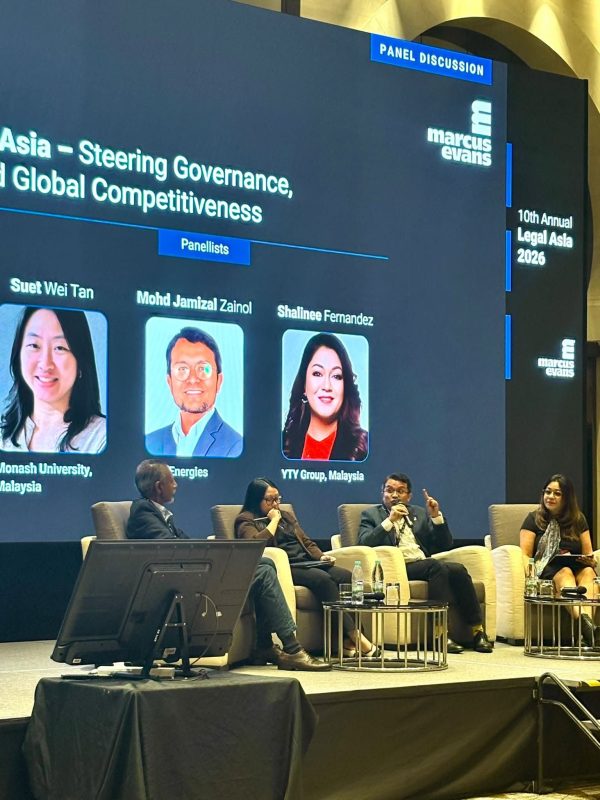
*Delivered the ideas above at Law Asia Conference 2026 on 11 August 2026 at Sheraton Imperial Hotel Kuala Lumpur.